The Fix Before the Flag: Inside a Working Day With the Bo'ness Mechanics
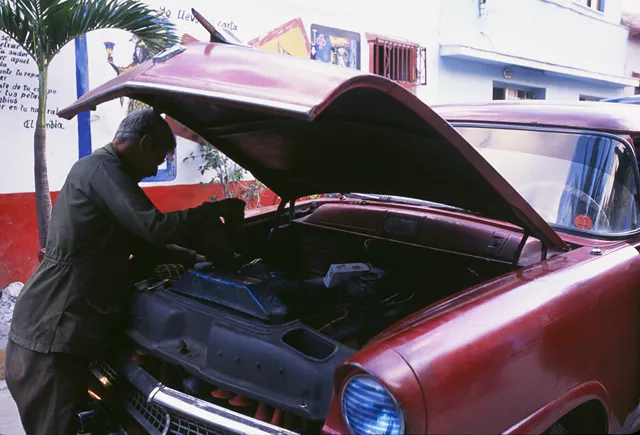
Photo: Unknown, Public domain, via Wikimedia Commons
There's a sound at Kinneil on a hillclimb morning that has nothing to do with engines. It's a ratchet, going back and forth somewhere under an awning, while the sky does its best impression of wet cardboard and somebody's kettle refuses to come to the boil.
By the time the first car is pushed towards the start line, most of the day's real work is already finished. Or it's already going wrong. Often both.
The Shift Starts Long Before the Cars Do
Paddock arrivals begin ridiculously early. Trailers are reversed into gaps that were measured by eye and optimism, awnings go up, toolboxes come out of boots, and someone always discovers that the thing they carefully loaded last night is sitting on a bench forty miles away in Falkirk.
"Half of my job is telling people their car is fine," says Dougie, a semi-retired engineer from Grangemouth who has been spannering for club-level competitors for the better part of three decades. "The other half is telling them it isn't, and doing something about it before the next batch goes up."
That's the rhythm of it. Hillclimbing is short runs and long waits, which means the working day isn't shaped by a race distance but by a timetable. You have a window. Sometimes it's forty minutes. Occasionally it's eight.
What Actually Breaks
Ask anyone who works on hillclimb cars and the list is refreshingly unglamorous. Clutch cables. Throttle linkages that have been adjusted one time too many. Ignition components that were fine in the garage and are mysteriously not fine at seven degrees with a damp haar rolling in off the Forth. Fuel pumps that object to heat soak after a run. A sheared engine mount. A perished hose that has been perished since about 2019 and has now decided to make a point of it.
"It's rarely the big dramatic failure," Dougie says. "It's the small daft thing that stops you getting to the line. A car that won't idle will still get up the hill. A car that won't start won't."
Cold starts do a lot of the damage. A hillclimb car spends most of its day stationary, then gets thrashed for less than a minute, then sits again. Batteries sulk. Plugs oil up. Nothing gets properly warm. It's a hard life for a machine, and an even harder one for the person trying to keep it sweet.
The Fix You Can Actually Finish
Here's the bit that separates paddock engineering from workshop engineering: it has to be done in time.
A textbook repair that takes three hours is worse than a scruffy repair that takes twenty minutes, because the second one gets the car on the hill and the first one gets it loaded onto a trailer at lunchtime. Judgement, not perfection, is the skill.
"You're always asking yourself how long it'll take," says a mechanic from Armadale who looks after a modified saloon and wishes to remain anonymous on the grounds that his welds are between him and his conscience. "If I can't finish it before the next run, I don't start it. I patch it, I cable-tie it, I tell the driver to short-shift and keep an eye on the gauge, and we sort it properly at home."
Hence the paddock vocabulary. Chemical metal. Jubilee clip. A length of hose that mysteriously fits. A blob of silicone that would make a concours judge weep. The improvised repair is a genuine discipline, and half the toolbox exists to support it.
From the Roadside to the Awning
None of this is new, of course. The hill at Bo'ness saw competition from the 1930s through to the mid-sixties, and the men who prepared those cars worked in the open with a canvas sheet, a hand pump and a set of Whitworth spanners. Trials-style improvisation was simply how motoring worked. If a magneto played up, you didn't ring a supplier — you took it apart on a wall.
What's changed is the kit around the car rather than the logic inside the mechanic's head. There are generators now, and tyre warmers, and laptops quietly logging things nobody looks at until something goes pop. But the decision-making hasn't moved on much. Something is broken. Something must be done. Something must be done fast.
The Unpaid Half of the Entry
Most of these people aren't on a retainer. They're mates, fathers, partners, retired fitters who like the noise and the company. They get a bacon roll, a cup of tea, and a vague promise about petrol money. They also get the particular joy of watching a car they fettled at dawn go up the hill cleanly at eleven.
And then, when the last car has come down and the awning is being folded, the real shift starts. The winter one. That's when the bodge gets undone and the proper job happens — which is a story for another month entirely.
"It's a daft hobby," Dougie admits, wiping his hands on a rag that was clean an hour ago. "But when it fires first time on the line, and you hear it go, that's the whole thing paid for."