The Kettle, the Spanner and the Deadline: Why November Rebuilds Matter
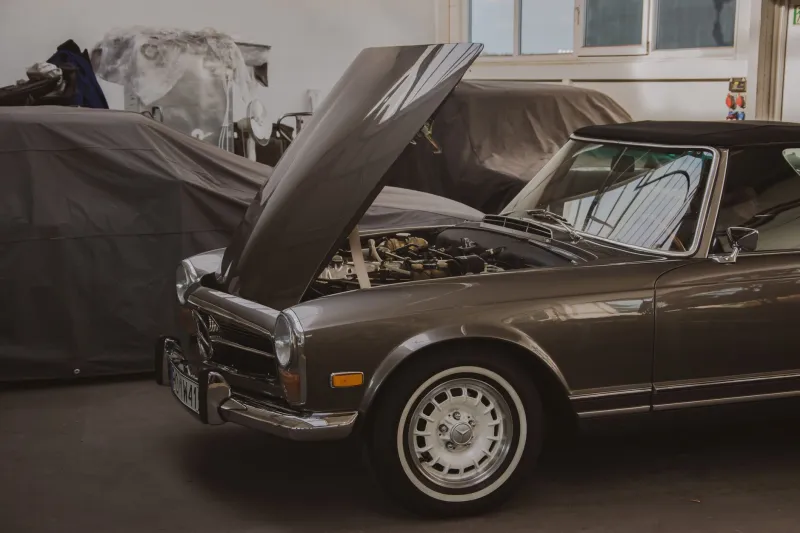
On a damp November morning, a Scottish workshop can feel a long way from a hillclimb start line. The kettle is on, the roller door is half up, and a historic competition car sits with its bonnet off and its wheels in a neat stack. The 2026 season is winding down. Trailers are being backed into sheds, results are being argued over, and the Bo'ness Revival is already becoming a memory. Good. This is when the real work starts.
The summer meeting is the shop window. The winter rebuild is the workshop behind it. There is a strong case that Scotland's historic hillclimb cars are not truly made in September; they are made in the quiet months, when there is time to inspect, repair and improve rather than just clean and refuel. If you love these cars, the off-season is not a dead period. It is the most interesting part of the story.
The Season Ends, the Workshop Begins
Hillclimbing is hard on machinery. A short course does not mean an easy life: cold starts, repeated full-throttle climbs, heavy braking and a driver working to a clock. By the end of a season, a car has told you what it needs. Bearings have been singing, a gearbox has been baulking, a crack has appeared in a bracket, and the paint has picked up another season of stone chips. November is when those messages are read properly.
The first job is rarely glamorous. It is the strip-down: body panels off, fluids drained, engine and gearbox separated, suspension inspected, wiring checked. Then comes the list. Some of it is safety: belts, seats, fire extinguishers, cut-off switches, roll cages and fuel lines. Some of it is reliability: bearings, seals, gaskets, hoses and cooling. Some of it is performance: a fresh set of tyres, a rebuilt differential, a better pedal box. A historic car that is MOT-exempt still has to be competition-safe, and that distinction is where good preparation lives.
What Actually Comes Apart
A typical winter rebuild is a series of small projects wearing a large coat. The engine may be stripped, measured and crack-tested; valves may be re-seated, bearings replaced and the block cleaned. The gearbox may be opened for a noisy second gear. The back axle may get new seals and a check of the crown wheel. Brakes are overhauled, not just pad-swapped. Suspension bushes, bearings and dampers are inspected. The steering is checked for play. Wiring is repaired where it has been cooked by heat or shaken by vibration.
Then there is the bodywork. Historic cars wear their history, and not every dent needs to be erased. But cracks in aluminium, tired fibreglass and rusty steel need attention before they become a retirement. Paintwork may be refreshed, or it may be left alone to keep the patina. Trim may be repaired. A new seat insert may be made. A dashboard may be rewired. The work is unglamorous and endlessly detailed, and it is exactly why the cars finish a damp Bo'ness run in September.
The People Behind the Patina
The winter rebuild is also a people story. In workshops across Scotland, there are machinists who can make a part that no longer exists, fabricators who can repair a chassis leg, trimmers who can stitch a seat to fit a driver, and engine builders who know the sound of a bearing before it fails. There are volunteers who hold the torch, make the tea and remember where the good spanners live. There are apprentices learning by doing, not by watching a video.
These are the craftspeople who keep historic hillclimbing alive. They are not usually in the spotlight. Their work is measured in clearances, torque settings and quiet reliability. But without them, the paddock at Bo'ness would be a static display. The Revival is a celebration of Scottish hillclimb heritage, and the winter rebuild is where that heritage is maintained by hand.
Why Follow a Winter Build?
There is a practical reason to follow along as the 2026 season winds down. Build diaries and workshop updates are a way to learn how these cars work, why they break and how they are fixed. They also make the next season more interesting: when a car appears at Bo'ness, you know what went into it. Many workshops welcome genuine interest, and some run open days or share progress online. If you are a classic-car fan, it is a chance to see the machinery behind the machinery.
There is also a community reason. Historic motorsport depends on people who turn up, ask sensible questions and support the work. You do not need to be a mechanic to be useful. You can share a build thread, offer a spare part, volunteer at a working day or simply turn up to a pre-season test with a flask and an encouraging word. The off-season is quieter, but it is not closed.
A Second Life, Not a Museum Piece
The best historic hillclimb cars are not preserved in aspic. They are used, repaired and used again. That cycle is what gives them a second life. A car that has been rebuilt over winter is not just a restored object; it is a machine with another season ahead of it. The 2026 season may be ending, but the 2027 car is already taking shape in a cold workshop.
So when the rain comes down and the hill is quiet, do not write off the winter. The kettle is on, the spanner is turning, and Scotland's historic hillclimb cars are being made ready for another go. That is worth following.