Grip, Bite and Nerve: The Start-Line Art of a Bo’ness Climb
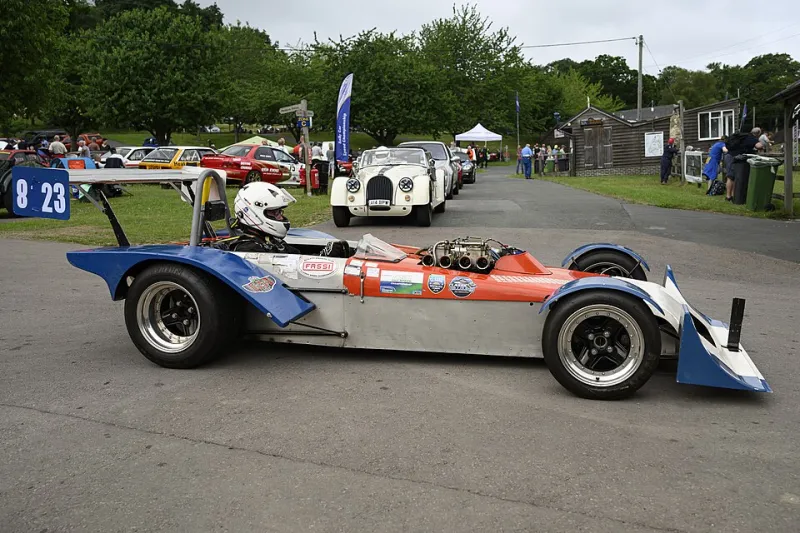
Photo: ChristopherJClarke, CC BY-SA 4.0, via Wikimedia Commons
The start line at Bo’ness is not a dramatic place. There is no grid girl, no bank of lights, no choreographed countdown. There is a marshal, a flag, a car, and a short stretch of tarmac before the brae begins to bite. It is also where a surprising number of runs are effectively settled.
Not because the hill gets easier later — it does not — but because the opening metres set the tone for everything that follows. A clean launch buys rhythm, temperature and confidence. A messy one costs time you spend the rest of the climb trying to recover. Ask anyone who has stood at the start with a clipboard, a stopwatch or a spanner, and they will tell you the same thing: the top of the hill gets the glory, but the bottom of it gets the job done.
The bit nobody films
Spectators tend to gather where the cars look fastest. That usually means the steeper sections, the bends with a bit of camber, the places where a well-driven Escort or a snarling single-seater can be made to look heroic. The start line gets a smaller crowd. It is a mistake.
The launch is a small piece of theatre with a very practical purpose. The driver has to bring the car to the line with tyres at something like the right temperature, brakes clean, engine settled and head clear. Then, in the space of a few seconds, they have to convert all that preparation into forward motion without bogging, spinning or frying the clutch.
At Bo’ness, the paddock-to-start routine is part of the craft. Cars do not arrive at the line cold and hopeful. They are warmed, checked, queued and nudged into position. The good crews treat the approach as part of the run, not a preamble to it.
Warming tyres without warming tales
Historic hillclimbing is not Formula One. You will not see tyre blankets and laptop screens at every trailer. What you will see is experience: drivers who know that a road-legal tyre or a period-pattern race tyre needs a little heat before it will work, but not so much that it goes off before the flag.
A gentle weave on the approach, a careful check of pressures, a brush of the brakes and a look at the surface are all part of the ritual. On a damp Bo’ness morning, the start line can be greasy while the upper hill is drying. On a warm afternoon, the opposite can be true. The driver who launches on the assumption that the whole hill is one consistent surface is the driver who gets caught out.
Paddock observers tend to notice the quiet ones. The crew that checks tyre pressures twice. The driver who walks the first few metres of the start area before getting belted in. The mechanic who gives the front tyres a quick feel with the back of a hand. None of it looks dramatic. All of it is data.
Clutch, revs and the bite point
The launch itself is a negotiation. Too few revs and the engine labours; too many and the rear tyres light up while the car goes nowhere. The sweet spot is different for a torquey Ford sidevalve, a screaming Imp engine and a modern-ish competition machine, which is why advice from the paddock is always model-specific.
What does transfer across cars is the need to know the bite point before the flag drops. Experienced hillclimbers will hold the car on the clutch or the handbrake, find the point where the drivetrain begins to take load, and then release with intent. The worst launches often come from a driver who is still searching for that point as the marshal’s arm falls.
Launch revs are a similar story. More noise does not mean more speed. A controlled launch, with the tyres just on the edge of grip and the engine kept in its useful range, will usually beat a theatrical wheelspin every time. The stopwatch is not impressed by drama.
What the timekeepers notice
Timekeepers at Bo’ness see every launch, from the smooth to the scrappy. They are not there to judge style, but they do notice patterns. A car that creeps forward before the signal, a driver who reacts late, a clutch that slips audibly, a set of tyres that chirps and then grips — these are the small tells that separate a composed run from a compromised one.
The clock starts when the timing beam is broken, not when the flag is raised. That means reaction is not quite the same thing as it is on a drag strip. But a driver who hesitates, or who is still settling into the seat as the car leaves the line, loses momentum that is hard to find again. Smoothness off the line is worth more than a tenth of a second of bravado.
One timekeeper I spoke to described the ideal launch as “boring from the outside and quick from the inside.” That is about right. The best ones look almost uneventful. The car squats, the engine note drops a little, and the machine is simply gone.
Paddock rituals and the quiet tells
Every driver has a routine. Gloves on, belts checked, visor down, a word with the marshal, a glance at the gauges. Some tap the dashboard. Some pat the roof. Some sit in silence. The rituals are not superstition, or not only superstition. They are a way of slowing the moment down.
For newcomers, the lesson is to build a routine that covers the essentials and then stick to it. Check the tyres. Check the pressures. Know your bite point. Decide your launch revs before you are at the line. Listen to the marshal. Do not let the crowd, the queue or the car in front rush you into a mistake.
And if the launch goes wrong? Accept it, get the car up the hill safely, and treat the next run as a fresh start. Hillclimbing is a sport of small corrections. The start line is just the first place to make one.
Watching the start like you mean it
For spectators, the start is worth a proper look. Stand behind the barrier, keep the marshal’s sightlines clear, and watch the front tyres rather than the driver’s helmet. You will see the sidewall flex, the contact patch load up and the car either hook up or scramble. Listen for the revs dropping as the clutch bites. Watch the body squat. You will learn more about a driver in three seconds at the line than in half a minute at the top of the hill.
Bo’ness is a hill that rewards preparation. The brae will always take its share of attention, but the launch is where the bargain is struck. Grip, bite and nerve — in that order, and usually before the flag has finished falling.