A Hill With Its Own Accent: Bo’ness Against Doune and Dumbuck
Scotland is not short of hills that bite. Lump them together under ‘Scottish hillclimbing’ and you miss the point. Each venue has its own accent, its own hazards and its own kind of hero. Bo’ness is not Doune with more trees, and it is not Dumbuck with a shorter straight. It is a distinct course with a distinct place in the national story.
Same sport, different dialects
Doune has a reputation for tight, technical twists and a rhythm that punishes hesitation. Dumbuck, in its celebrated past, is remembered for long straights and the sort of commitment that makes a small car feel very exposed. Bo’ness sits somewhere between those extremes, but not neatly. The Revival course winds through parkland, with cambers, bumps and surfaces that change character through the day. It rewards a driver who can read the road rather than simply remember it.
That difference matters because hillclimbing is not one skill. A course can be fast without being brave, or technical without being slow. Bo’ness asks for clean lines, good traction and mechanical sympathy. Doune asks for precision under pressure. Dumbuck asked for top-end nerve. Put the same driver in the same car at all three and you would get three different answers.
What Bo’ness asks of a driver
The Bo’ness hill is not a drag strip with a corner at the end. It is a sequence. Get greedy on the exit of one turn and you pay at the next. Get the car unsettled over a crest and the stopwatch shows it. The course favours a driver who can keep the tyres under the car and the engine on the cam without sawing at the wheel. In that sense it is a very Scottish kind of hill: not always dramatic to watch from the outside, but demanding to get right.
It also suits cars that are honest rather than exotic. A well-driven modified saloon or a sharp little sports car can look mighty here. You do not need a thoroughbred to enjoy Bo’ness. You need brakes that work, gearing that suits the climb and a driver who understands that smooth is usually quicker than spectacular.
Doune: precision under pressure
Doune’s reputation is built on tightness. It is a course that seems to close around the car, asking for accurate placement and a willingness to commit when the view ahead is limited. Where Bo’ness can reward a flowing approach, Doune often rewards a more surgical one. The margins are small, and the penalty for a missed apex can be immediate.
That makes Doune a wonderful spectator hill and a demanding driver’s hill. It also means the cars that shine there are often nimble and well set up rather than simply powerful. A screaming small-capacity machine can be in its element. A big, lazy engine might struggle to use its advantage.
Dumbuck: the long, brave conversation
Dumbuck belongs to the older, bolder end of the Scottish hillclimb story. Its long straights and open character gave drivers room to think about gearing, revs and nerve. It was less about threading a needle and more about holding a line at speed while the hill tried to make up its mind. Cars with strong top-end performance and drivers with a healthy disregard for self-preservation had an obvious advantage.
That is a different discipline from Bo’ness. At Dumbuck the question was often ‘how much?’ At Bo’ness it is more often ‘how cleanly?’ Neither is better. They are simply different conversations between driver, car and hill.
Classes, cars and course fit
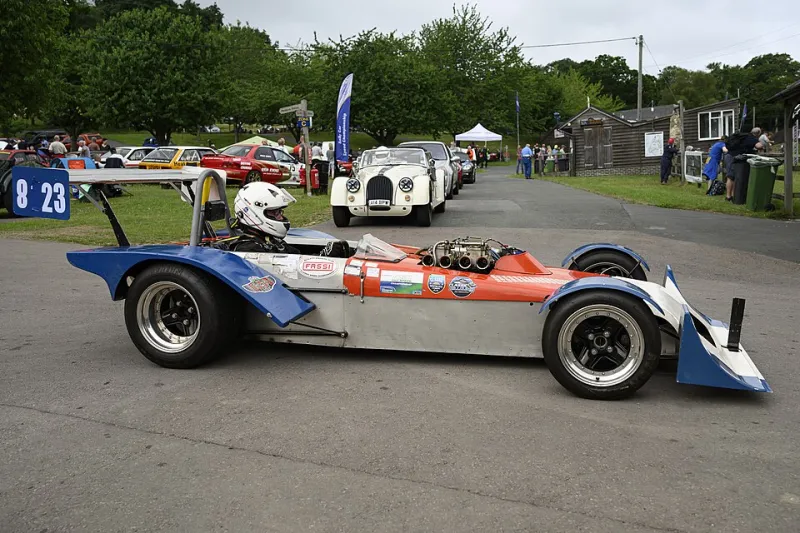
This is where the Bo’ness character really shows. Historic classes, club-level saloons and modified production cars all have a place, and the course tends to reward good preparation over pure spend. A car that starts, stops and steers properly can punch above its weight. A fragile exotic with poor cooling and a nervous driver can have a miserable weekend.
Doune can flatter a short-wheelbase car with sharp turn-in. Dumbuck could flatter power and long legs. Bo’ness asks for a broader package: usable torque, reliable brakes, good traction and a chassis that does not lose its composure over imperfections. That is why the Revival paddock is full of cars that look like they have been built by people who actually use them.
The spectator’s view
Atmosphere is part of the comparison too. Doune has the feel of a natural amphitheatre, with the hill doing much of the theatrical work. Dumbuck’s history carries the romance of speed and open space. Bo’ness offers something closer and more social: parkland, paddock access, the smell of hot oil and the sense that the cars have arrived from real garages rather than sealed museums.
The Revival’s historic flavour is not a costume. It is a reminder that hillclimbing in Scotland has always been a club sport as much as a spectacle. Spectators at Bo’ness can wander, listen, compare notes and watch a Mini take on a much larger machine. That accessibility is part of the course’s character, not an add-on.
A distinct place, not a duplicate
So how does Bo’ness measure up? It does not need to win a fictional contest against Doune or Dumbuck. It needs to be itself. Doune is the tight technician’s hill. Dumbuck is the long, brave memory. Bo’ness is the parkland all-rounder with a historic soul and a clubman’s heart.
That is why it belongs in the national hillclimb story rather than sitting at the edge of it. The Revival is not simply another round on the calendar. It is a course with its own demands, its own atmosphere and its own way of reminding drivers that the hill always has the final say.