The Truck That Waits: Inside the Quiet Readiness of Bo’ness Recovery
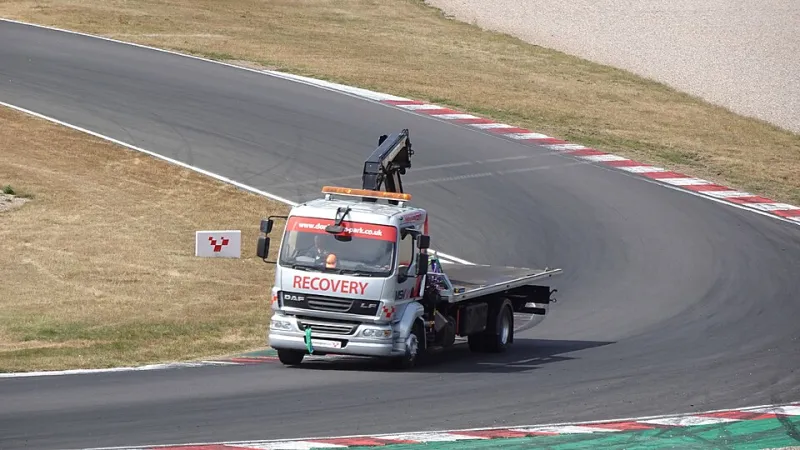
Photo: BWard 1997, CC BY 4.0, via Wikimedia Commons
At the foot of the Bo’ness hill, tucked away from the burger van and the scrutineering bay, there is a truck that rarely moves. Most spectators will never notice it. That is the point. The recovery crew are not there to be part of the show. They are there for the moment the show stops.
On a cold, bright morning at this year’s Bo’ness Revival, the truck sits with its ramps down and its winch covered. A pair of overalls hangs over the tailgate. Nobody is rushing. The crew have done this before. They know that the busiest part of their day is usually the part nobody films.
Before the First Car
Long before practice begins, the recovery team are already walking the hill. Not driving it — walking it. They look at access points, the width of the track at the hairpin, the soft ground behind the bank, the places where a car might stop and a truck might struggle to follow. Bo’ness is not a motorway hard shoulder. It is a narrow, steep, old-fashioned hillclimb course, and every metre of it has its own personality.
The checks are methodical. Winch cable wound evenly. Shackles inspected. Soft strops laid out so they can be grabbed without a search. Wheel chocks, spill kit, fire extinguisher, radio handset. The crew do not just check that the equipment is there; they check that it is where it should be. In a delay, muscle memory matters more than a clipboard.
They also talk to the marshals. That is the real pre-event check. A recovery crew that has not spoken to the people on the banks is a crew working blind. By the time the first car leaves the line, the recovery team know who is where, which radio channel is live and which marshal will be their eyes on the upper section.
Reading a Stopped Car
The first sign is usually a raised hand. A marshal’s arm goes up, a red flag comes out, and the hill goes quiet in that particular way a hillclimb does when everyone starts listening for news. The recovery crew do not move immediately. They read the situation first.
A stopped car is a message with several possible meanings. Is the driver out and walking? Is the car smoking? Is there fluid under the sump? Has it stopped on the racing line or tucked into the bank? Is the engine still running? The crew are looking for the difference between a stalled engine and a problem that needs the fire extinguisher before it needs the winch.
From a distance, they also read the marshal. A marshal who is waving the recovery truck forward is saying one thing; a marshal who is holding position is saying another. The recovery crew are not freelancing. They are part of a chain that runs from the clerk of the course to the radio to the marshal to the truck. The best recovery work looks boring because nobody has skipped a link.
The Delicate Bit
This is where the job gets interesting. A modern recovery truck can drag a car out of a ditch in minutes. Doing it without adding a crease to a 1960s Elan, a fibreglass special or a carefully patinated saloon takes longer. Bo’ness is a historic meeting, and the cars in the paddock are often older than the people driving them. Recovery is not just about clearing the hill. It is about preserving the reason people came.
The crew will usually look for a strong point underneath — a chassis rail, a suspension mount, something the manufacturer intended to carry load. Soft strops go around the structure, not the bodywork. If the car has stopped awkwardly, wheel dollies may come out. The winch is used gently, with someone watching the car’s attitude and someone else watching the ground. A classic that has just had a bad run does not need a second one on the end of a cable.
Scrutineers may also want a look before the car disappears back to the paddock. That is part of the coordination. The recovery crew are not mechanics and they are not judges. They are the people who move a car safely so that the right people can do their jobs next.
Getting the Hill Moving Again
The hill runs on radio traffic as much as petrol. When a car stops, the delay ripples outward: the next runner waits at the start, the marshal on the bank holds the gap, the commentator fills the silence, the crowd checks its programme. The recovery crew are near the bottom of that chain, but their work is what lets the chain start moving again.
Once the car is clear and the marshal has confirmed the track is safe, the clerk of the course can release the next run. The recovery truck rolls back to its spot. The straps are coiled. The ramps go up. To the spectator, it looks like nothing happened. To the crew, it is the end of a small operation that had to go right first time.
No Lap Times, No Applause
You will never see the recovery crew on a results sheet. They do not take a start line, they do not get a time and they do not get a cheer when they finish. Their best days are the ones where the truck never leaves its patch and the only thing they recover is a dropped glove from the paddock.
But a hillclimb needs them. Bo’ness is a celebration of Scottish hillclimb heritage, and heritage is fragile. It is old cars, narrow banks, steep approaches and people who care enough to keep them running. The recovery crew are part of that care. They are the quiet insurance policy behind every run — ready for the worst, hoping for nothing, and keeping the hill moving one careful recovery at a time.